On our way to Kumbhalgarh, we stopped at a stunning Jain temple in Ranakpur— the sort of place that makes you instinctively lower your voice, walk a little slower, and pretend you understand architecture.
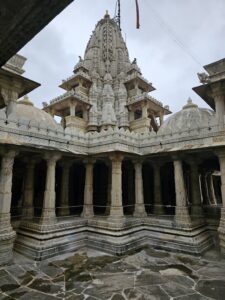
Our guide cum priest, pointed to an intricate sculpture on the ceiling. “This,” he explained solemnly, “reminds us to leave our ego and identity outside before entering the temple.” A beautiful sentiment. Leave behind your titles. Leave behind your status. Leave behind the labels that separate us. I nodded thoughtfully, contemplating the wisdom of centuries.

Then I walked toward the inner sanctum. A temple attendant stopped me. “Foreigners are not allowed inside.” I blinked. A foreigner? Now, I should point out that I was standing there in full Indian glory. Brown skin. Indian features. Indian clothes. Indian accent. The complete package. Yet somehow, I had apparently wandered into a demographic category that required further investigation.
The timing was exquisite. Thirty seconds earlier, I had been instructed to abandon my identity. Now I was being asked to produce one.
I briefly considered explaining that my family tree had been rooted in the Indian subcontinent for so many generations that it probably qualified as an archaeological site. Should I be carrying a DNA card? Perhaps a laminated certificate: “Certified Indian. Heritage verified continuously since approximately 2500 BCE.” Maybe with a QR code linked to my human genome report.
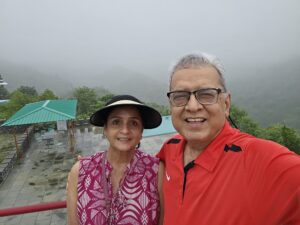
The attendant remained unconvinced by my face alone. I wanted to ask what exactly had triggered the suspicion. Was it my visor? My phone case? The fact that I looked mildly confused? Mild confusion accompanies most of my travels as faithfully as my camera and sunscreen. In fact, looking slightly bewildered may be one of the most authentic Indian experiences available. The matter was eventually settled when my husband stepped forward and vouched for me in Hindi. And just like that, my citizenship was restored. No passport required. No Aadhaar card. No ancestry report stretching back to the last ice age. Just one husband speaking Hindi with sufficient confidence. I was waved through, presumably having passed the final round of the eligibility process.
As I entered the sanctum, I reflected on the lesson from the ceiling sculpture. Perhaps I had misunderstood. Maybe leaving your identity outside only works until someone asks for it back. And so, in the span of five minutes, I learned two profound truths:
- Spiritual enlightenment requires surrendering the ego.
- Administrative procedures may still require supporting documentation.
The temple itself was magnificent, serene, and worth every moment of existential confusion. But I left with one lingering concern. If someone who looks unmistakably Indian can be mistaken for a foreigner, what hope is there for the rest of us? On future trips, I may travel with a passport, an Aadhaar card, and a notarized statement from the Indus Valley Civilization.
Just to be safe.
…. from Gita’s Chronicles of Chronically Underwhelming Experiences
Comments
3 responses to “Ranakpur and My 4,500-Year-Old Indian Credentials”
ROFL 😂
You’re asking good questions! Honestly it’s been an existential reality for me since childhood. I was born an Indian and Hindu, but brought up in Japan by my Japanese mother and Indian father. My sister and I were gaijin/foreigner no matter how Japanese we were in language, manners, dress. We mostly didn’t take it personally but went with the flow. And whenever we went to India, we were foreign despite our passports. My father lived in Japan for 65 years but he was an Indian all his life. More than anything it’s what is in your heart….are you an Indian…or American? Or just a human being as that temple ceiling tried to portray….? If only we could just be human, the world would be a better place. 🙏☮️🕉️❤️
That’s the sharp end of it, isn’t it. If a Tagore — a name that gave India its national anthem, a Nobel laureate, arguably the most Indian cultural export there is — can be asked to prove they belong, then “foreigner” has stopped being a description and become a weapon. It’s not really about paperwork at that point. It’s about who gets to decide, on any given day, who counts.
The bitter joke is that the people usually asked to produce these proofs are rarely the ones with generations of documentation lying around — land deeds, school certificates, the paper trail of a settled, literate, urban life. They’re often the ones history moved around the most: displaced by partition, floods, or poverty, exactly the people least equipped to satisfy a bureaucracy built to trust paper over presence. A name like Tagore surviving that scrutiny is a fluke of privilege, not proof the system works. It just makes the absurdity legible to people who’d otherwise look away.