(How I Outsourced My Brain)
I have always been a list person.
Not in a casual “jotting things down on a sticky note” kind of way.
I mean a deeply, spiritually committed, color-coded, categorized, cross-referenced list person.
My spreadsheet isn’t just a to-do list. It’s a philosophy. It’s evidence that life, at its most chaotic, can still be tamed — or at least nudged toward something manageable.
My lists have sections. Categories. Time slots. There are probably subcommittees.
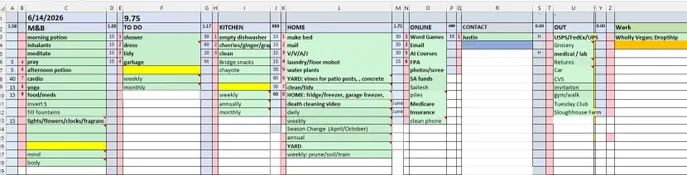
Morning tasks: morning potion, meditation, prayer, cardio, yoga. Afternoon tasks. Kitchen tasks. Home tasks. Online tasks. Contacts. Things I need to do out in the world. Food to cook. Work to tackle.
And yes — fragrance to refresh, lights to check, fountains to fill. If spontaneity showed up, it needed an appointment.
And here’s the thing: it felt amazing.
Each checkmark was a tiny victory. Each completed column — TO DO, KITCHEN, HOME, ONLINE — a small but satisfying proof that I had bent chaos, just slightly, to my will. I wasn’t just living life. I was managing it.
I didn’t choose the list life. The list life chose me.
My earliest memories of “productivity” don’t involve planners, apps, or color-coded systems. No — mine began on my left palm. Tiny, earnest scribbles of things-to-do, etched in pen like a contract with the universe.
Unfortunately, the universe had other plans.
Soap. Water. Hygiene.
Every hand wash was a betrayal. Entire futures — buy glue, finish homework, conquer world — vanished into the sink. I’d emerge with clean hands and a vague sense of existential loss.
So I evolved.
I migrated to paper and pencil.. Glorious, reliable paper. And not just any scribbles — this was structure. Discipline. A system.
The Payless Drugstore Incident (or: When Lists Become Lifelines)
Then came the day I lost my list.
Not metaphorically. Literally.
Somewhere between browsing and bad decisions at Payless, I misplaced my sacred paper — the master list, the blueprint of my immediate future.
Panic is too mild a word.
I retraced my steps like a detective in a low-budget thriller. I scanned shelves. I interrogated my memory. And finally, I did what any rational person would do: I went back and begged.
“Please,” I must have said, with the urgency of someone who had misplaced not paper, but purpose. “Have you seen a list?”
Because that’s what it was, wasn’t it? Not just a list.
A map. A plan. A sense of control.
Without it, I wasn’t just disorganized. I was unmoored.
Digital Salvation
Eventually, I modernized.
From paper, I graduated to pixels. First Evernote. Then OneNote. Then — naturally — a sprawling, glorious Excel spreadsheet with multiple sheets: To Do, Kitchen, Home, Food, Routine, Accounts, even a dedicated India sheet for my trips back home.
Tabs for the yard. Tabs for diet and exercise. A whole sheet just for groceries, broken into berries, avocados, greens, alliums, cruciferous vegetables, whole grains.
A lesser person might call this excessive. I call it comprehensive.
Now my lists don’t get lost at Payless. They sync. They follow me across devices like loyal companions. My past, present, and future — all neatly itemized, color-coded, and backed up.
And then I went one step further.
Each task in my spreadsheet has two things next to it: a priority number and a time estimate.
The priority column sorts each category so the most important thing floats to the top — shower before tidying, mail before laundry, the urgent before the merely necessary.
And the time estimates — 15 minutes for the morning potion, 40 for cardio, 30 for the dishwasher — roll up into a total for each category: M&B, TO DO, Kitchen, Home, Online, Contacts, Out.
Each category shows its running hour count at the top. And all of those feed into a single number at the very top of the sheet — today’s total committed hours.
Today: 9.75 hours. Accounted for. Spoken for. Planned.
It sounds intense. It is intense. But there’s something almost meditative about it.
The priority column means I never have to decide in the moment what matters most — that decision was already made, calmly, in advance.
And when a category’s hours creep too high, I know I’ve overcommitted before the day has even started. When the total looks reasonable, the day feels possible — like it has room to breathe.
The spreadsheet doesn’t just tell me what to do, or even when. It tells me what matters most — and whether it’s all actually doable.
That’s not obsession. That’s wisdom with a SUM formula and an ORDER BY clause.
There’s something deeply comforting about opening a document and seeing your life… outlined — and timed.
Creativity vs. Control
Now here’s the uncomfortable question I sometimes ask myself:
Am I overly dependent on this?
Am I compensating for some lack of innate spontaneity? The kind of person who doesn’t flow through life, but rather itemizes it?
Maybe.
But here’s the counterpoint: look at what those lists actually contain.
My spreadsheet tracks my morning potion and meditation, yes.
But it also holds dream trips to India — days in Pondy Bazaar, Hampi temples, Kanchi, a dance performance in a sari.
It holds recipes I want to try — rose burfi, coconut curry, garlic spaghetti, bruschetta from scratch.
It holds books I mean to read, films I want to watch, garden plants I want to grow — drumstick, jasmine, jackfruit, gardenia.
It holds family, friends, people I love and need to call.
My lists aren’t a cage. They’re a container for everything that matters.
I plan my work — and then I work my plan.
Lists don’t limit me. They liberate me. They quiet the noise in my head.
They take the swirl of “don’t forget this” and “what about that” and turn it into something tangible. Manageable.
They give me the freedom to be present, because I know nothing important is slipping through the cracks.
So… Am I Abnormal?
Perhaps a little.
But everyone has their coping mechanisms. Some people meditate. Some people journal. Some people wing it and thrive in chaos.
And then there’s me — with my beautifully structured, obsessively maintained, occasionally life-defining lists.
Thirteen sheets deep. Color-coded. With a dedicated tab for the pool service and one for spiritual chants and one for the grocery run.
If that’s abnormal, I’ll take it.
Now if you’ll excuse me…
I need to add “finish blog post” to my list. ✔️
P.S. Yes, I do build a buffer period into each day. For spontaneity. For emergencies. For the unexpected.
In practice, this mostly means being available when the kids or the husband decide that whatever is happening in their lives at that exact moment constitutes a crisis. It usually doesn’t. But I’m scheduled to care — and that’s what matters.
On July 15, 2026, Sam Kantimathi (SamTimer) posed an intriguing question: was my Excel to-do list missing some of the key principles behind the Eisenhower Matrix? Curious to find out, I took a closer look—and the result was this blog post: The Eisenhower Matrix and My Excel To-Do List