‘Paadaravaa’ (paad’ur-va) — noun
As defined in the Tamford Dictionary:
1. People who sing.
2. Amateurs who lip-sync behind one or two talented people.
3. Enthusiasts who long for Golu invitations from strangers, primarily to parade their entire saree collection.
Note to aspiring Paadaravaas:
Membership is not for the faint-hearted—or the perfectly in-tune. Auditions are held around July for the upcoming Navarathri season. If you manage to maintain Sruthi through one full Charanam, you will be summarily disqualified. Please email your interest (and your tolerance for off-key enthusiasm).
And that, dear friends, was how we introduced ourselves to the community—tongue firmly in cheek and Sruthi nowhere in sight. What began as a parody soon turned into a phenomenon.
It all began with five of us. That first Navarathri, our ever-patient first Paadaravaa guru, Subha Yeddidi, taught us a few simple songs. The real goal, however, was not divine enlightenment—it was to wangle invitations, air out our silk sarees, and feast our way through the season.
Over the next nine years, we got more talented members; our numbers swelled—at one point, we hit a glorious 27 members—and our repertoire expanded with each passing season. Our pre-Navarathri rehearsals were legendary: equal parts laughter, misplaced notes, and Ragi or Oats Morekali. Honestly, I suspect most came for the snacks and left because of the singing.
As for me, I was no musician. I could barely stay in sync with the experts, so I took on the role of Master Scheduler—armed with the fancy tambura that made me look vaguely legitimate. My true contribution? Comic relief between kritis.
For the record, it took me two full seasons to learn that the button I pressed wasn’t called Madhyamavathi—that’s a ragam—it was Madhyama. My daughter kindly pointed this out, using the same tone she had when she reminded me that during my brief stint teaching the Bala Ramayana, the children knew far more than I did. (That’s a story for another day…)
Every year, we begin our musical circuit on Mahalaya Amavasya, debuting our newest songs at the temple. For the next ten days, we could be spotted zooming around Sacramento—decked to the hilt in silk and gold, sometimes leading convoys of up to eight cars, occasionally lost but never off-key (well, not entirely). In Sacramento, Navarathri was celebrated morning, afternoon, and night—which meant an exhausting rotation of sarees, songs, and sundal.
For a while, we were in demand. Invitations arrived addressed specifically to “The Paadaravaa.” For a brief, shining moment, we were the toast of Navarathri. We basked in our fifteen minutes of Navarathri fame—and loved every second of it. But managing 27 women across 10 days and multiple counties? Even the goddess Saraswathi would have thrown in her veena.
Then one day, my mother returned from India with two sarees covered in musical instruments—and a giant veenai splashed across the pallu. A lightbulb moment!
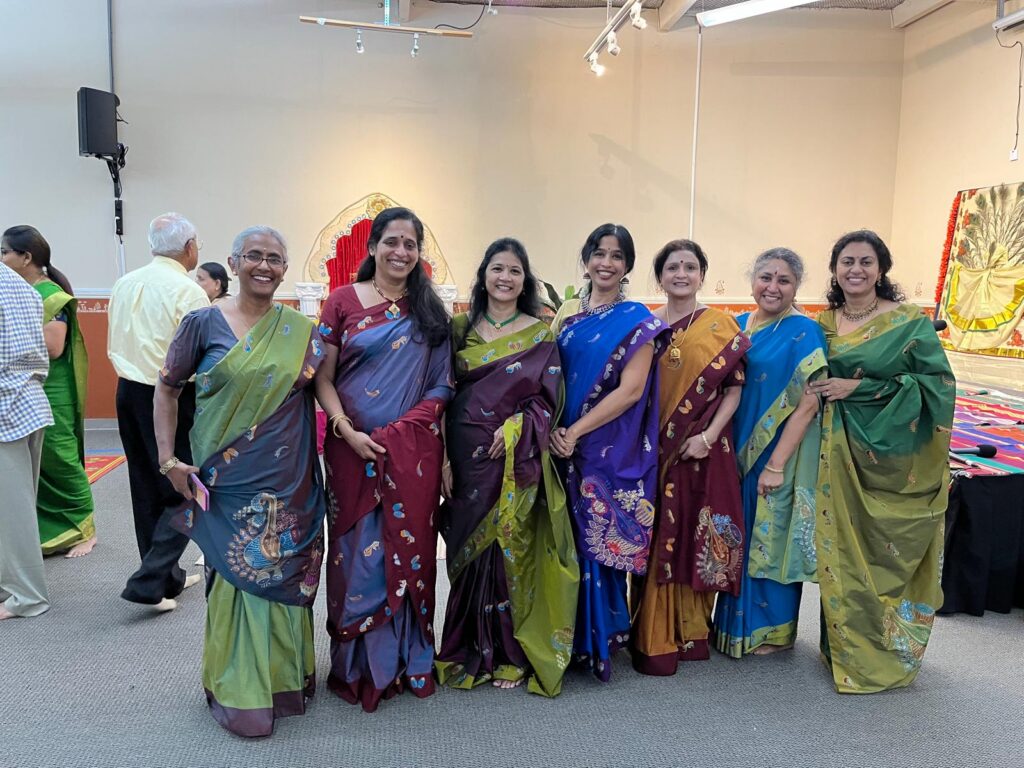
On her next trip, she chased down that itinerant salesman and ordered 30 of the same saree in different colors. One Friday before what would become our final grand performance, all our musical friends gathered at my place and claimed one. And thus, we evolved—metamorphosed!—into The Kekaravaa. (Some days, depending on enthusiasm and menu, we’re also known as The Saapadaravaa.)
All is not lost, though. We’ve redirected our many talents—singing, teaching, and scheduling—toward Subo’s annual Bhajan Day. Occasionally, upon invitation, we transform into the Wedding Belles, performing songs so inspiring that priests have been known to speed up the ceremony.
And that, dear friends, is the saga of the Paadaravaa—proof that while talent is optional, good humor, good company, and a great saree are essential.
YT:
Roster of the most steadfast Paadaravaa — our longest-serving members (in alphabetical order):
Bharathi Rajan: She introduced us to the Sharade Stotram and continues to be a guiding light—a true Guru in every sense.
Eshwari Kumar: Confined to a wheelchair, but limitless in enthusiasm.
Geeta Mahendra: A teacher extraordinaire who can deliver an MSS classic at just a few hours’ notice.
Geeta Viswanathan: My personal go-to in moments of chaos; her calm composure has rescued many a performance.
Jayanthi Sridhar: Our resident Kannadiga, who patiently coached us through the trickiest Purandara Dasa lyrics.
Poorni Iyer: Inherently gifted; her talent refined further under the watchful eye of Vishalam Mami.
Prabha Viswanathan: Easy-going, ever-gracious, and the host everyone loves to sing (and eat) with.
Raji Ramani: A brief but delightful interlude in the Paadaravaa symphony.
Rekha Gopal: Teacher, a talent, and a voice to die for.
Sangeetha Narayanan: Our talented Telugu representative, who, ironically, helped us perfect our Tamil diction.
Shanthi Iyer: Always willing to go the extra mile—and often the extra octave.
Subha Yeddidi: Our very first teacher, whose patience and guidance set the tone for everything that followed.
Subo Balasingham: Chief instigator and spark behind most Paadaravaa ventures, including the beloved Bhajan Days.
Sudha Tiags: Another of our talented Telugu crew who ensured our Tamil sounded almost authentic.
Sujata Rajagopal: Laali Aadinal was one of the many lilting treasures from this melodious voice.
Surya Jagannathan: A teacher par excellence, relentless in pursuit of perfection.
Vasanthi Gajendran: The undisputed fashion icon of Paadaravaa—proof that musical grace and style can coexist beautifully
Vasudha Padmanabhan: Brimming with talent; continues to enrich the community through Sacramento Aradhana.