Reaching Jaisalmar
Most airport pickups involve a name scrawled on cardboard. Ours involved marigolds.
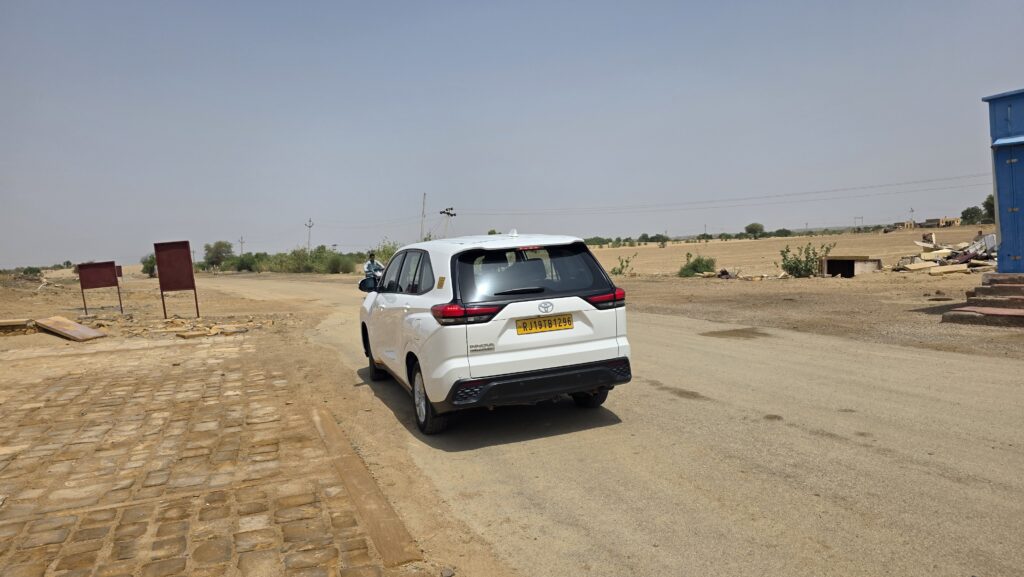
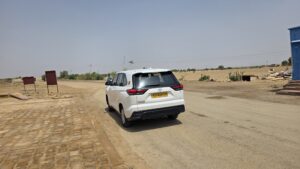
We landed in Jodhpur to find Ratan Singh standing on the tarmac of the arrivals area like he’d been cast for the role — marigold garlands in hand, bottles of ice-cold water held out like a peace offering to two dehydrated travelers. Ratan Singh has driven us on previous trips across North India, so this reunion felt less like meeting a driver and more like catching up with an old friend who happens to own excellent air conditioning. This time, though, my husband — ever the details person — had specifically requested the newer Innova Hycross for the drive, and its shiny automatic gearbox slowed us down considerably because it turned out to be a first even for a veteran like Ratan Singh.
Four hours is also exactly the right amount of time to watch Rajasthan change color. Jodhpur’s blue rooftops gave way to scrubby gold plains, then to actual dunes, then to Jaisalmer rising out of the desert like a sandcastle that had decided to become a real fort. The Thar doesn’t announce itself gradually — one minute you’re passing wind farms and roadside chai stalls, the next you’re squinting at a honey-colored skyline that looks suspiciously like it was built for a movie set. Somewhere in the middle stretch, the scenery turned into a proper agricultural cameo — sandstone quarries giving way to fields of bajra and till, with cowherds standing around looking distinctly unemployed because their cows had all clocked out of being herded to photobombing our car windows instead. Not a single cow seemed interested in grazing. Every one of them had pivoted careers to “roadside celebrity.”
Lunch was at a dhaba so fancy it bordered on surreal: we were the only guests in the entire place, and yet somehow 152 staff members materialized to greet us with the kind of enthusiasm usually reserved for visiting heads of state. We have never felt so outnumbered by hospitality in our lives.
We rolled into Jaisalmer slightly sun-dazed and thoroughly garlanded, the flowers having held up in the heat rather better than we did.
Checking In, Rajasthani-Style
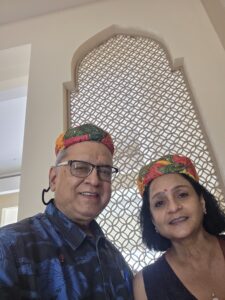
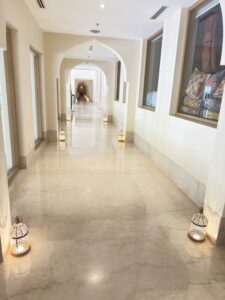
The Marriott met us with bandhani headgear and a welcome drink so cold it practically apologized for the heat outside.
Very regal. Very Instagrammable.
What the brochure does not mention is that our suite came with its own small mysteries: two TVs, of which exactly one could function at any given time, as if they’d unionized and were taking turns; and two bathrooms, both proudly offering water that identified as “lukewarm” no matter which tap you begged. A suite with commitment issues, basically. We loved it anyway.
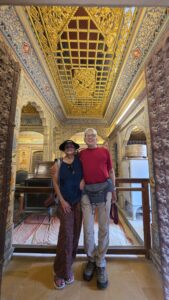
Vikram, Guide by Day, Photographer by Vocation
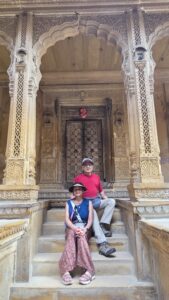
The next morning we met Vikram, our multilingual guide who turned out to be a professional-grade photographer moonlighting in tourism — or possibly the other way around. Either way, we have never been so expertly posed in front of a fort in our lives.
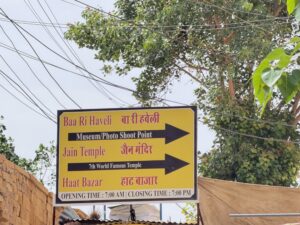
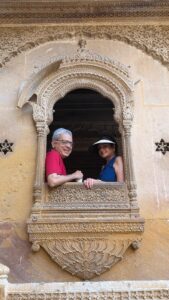
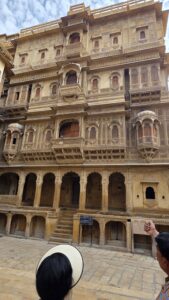
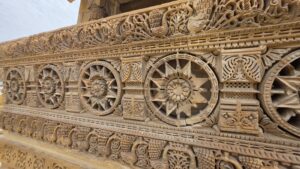
And what a fort. Jaisalmer earns its “Golden City” title honestly — the whole town is built from the same warm sandstone, so at certain times of day the entire skyline looks lit from within. The Patwa Havelis, once the private mansions of a wealthy merchant family, are the kind of over-the-top old-money architecture that makes you reconsider your own career choices. Carved sandstone balconies stacked five stories high, for people who apparently just wanted to flex on the neighbors in the 1800s.
We also made it to the Haat Market, which we can only assume is a charming local misspelling of “Hot,” because that is precisely what it was. Every surface in Jaisalmer had opinions about the sun that morning, and the market’s were the strongest.
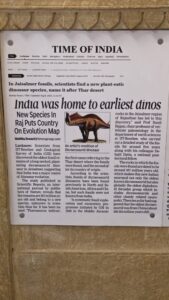
Here’s the plot twist nobody warns you about in the desert: 18 million years ago, all of this — the fort, the havelis, the haat, our entire itinerary — was underwater, sitting quietly at the bottom of the Arabian Sea. The proof is everywhere, in the form of marine fossils embedded right in the sandstone. As if that weren’t enough of a time-scale whiplash, the region also has dinosaur eggs on display, because apparently Jaisalmer’s résumé includes both “ancient seabed” and “dinosaur nursery” before it ever got around to being a desert.
By 10 a.m. the sun had officially revoked our outdoor privileges, so we beat a retreat toward the hotel, dodging a gauntlet of attar salesmen and camel-wool blanket vendors with the reflexes of seasoned tourists. We did, however, allow ourselves one splurge: a Habar stone water jug, famously beneficial because it’s carved from fossilized marine stone — the very same 18-million-year-old seabed we’d just spent the morning admiring in the fort walls. We’re hoping it cures whatever ails us, quite possibly including my own well-documented weakness for unnecessary shopping. Early data suggests it’s doing an excellent job with everything except that last part.
Sunset, Survived
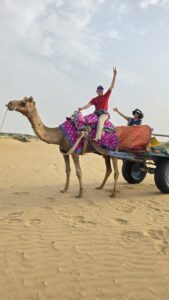
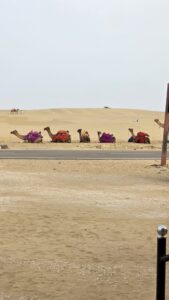
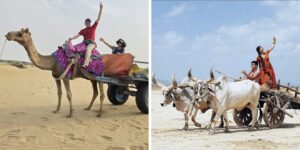
Come evening, a half-hour drive delivered us into the Thar proper, where a camel stood waiting to pull us into the sunset via cart — a mode of transport I approached with some trepidation, given my previous experience with camels. But we survived. We even came away with a photograph that looks considerably more romantic than either of us actually felt mid-lurch — which is really all you can ask of a desert sunset that then hands the sky off to a full desert moon.
That moon, as it happened, belonged to Guru Poornima, the festival for honoring one’s teachers. Perched on a swaying cart behind an unbothered camel, it seemed like the right moment to think about what our own gurus — the teachers, the elders, the ancestors whose wisdom got handed down long before either of us existed — might have made of this desert adventure. Something, presumably, about balance, about not gripping so hard, and about the general futility of pretending you’re the one in control up there. We took the lesson, photographed the moon, and got off the cart with our dignity roughly 70% intact.
From there it was on to an open-air amphitheatre for a variety show of music and dance, followed by dinner. I arrived early and, in a fit of helpfulness, offered to get the AC units going for the evening crowd — a job I executed with real enthusiasm, cranking every single one down to 60 degrees F., accidentally creating winter in the Thar Desert. Whether anyone thanked me for this or is still recovering from it, I couldn’t say.
Back in the suite, we caught the tail end of a Bollywood drama on the one functioning TV, which turned out to be exactly the kind of plot twist-per-minute programming required to keep two exhausted travelers awake well into the night.
Day 2 in Jaisalmar began slowly, which in retrospect was the correct pace for a day that would eventually defeat us by lunchtime.
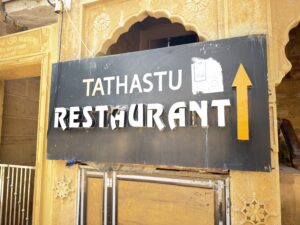
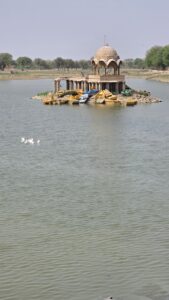
After breakfast, Ratan drove us to Gadisar Lake, which announces itself as a lake but is, on closer inspection, really more of an ambitious pond with excellent PR. One restaurant on the lakefront, claiming a lineage back to 1567 AD, went by the name Thathastu — Sanskrit for “so be it,” or, as we preferred to translate it, “amen to that.” Four and a half centuries in business is the kind of longevity that makes you sit up and take the menu seriously. It also felt like an oddly fitting motto for the trip so far — automatic gearboxes, marine fossils.
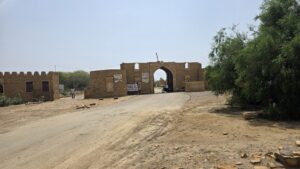
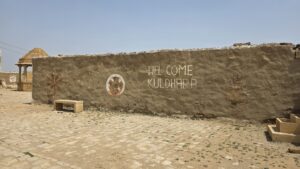
From there we headed to Kuldhara, the “empty village” — the remains of a cluster of 84 villages founded back in 1291 by the Paliwal Brahmins. The whole settlement was abandoned overnight in 1825; the threats of a cruel local minister sent everyone packing in a single night. Either way, walking through the crumbling lanes has a genuinely eerie quality — 84 villages’ worth of silence is not a small thing.
It also had me doing some unexpected genealogical math. According to my DNA results, at least one of my ancestors made their way from somewhere around the Caucasus down into northwest India, long before continuing south to Andhra. Standing in a 700-year-old village in exactly that stretch of the map, it was hard not to wonder whether some distant relative of mine had once walked these very lanes, several centuries and several life choices removed from ending up as a tourist here with a water bottle and questionable sun protection.
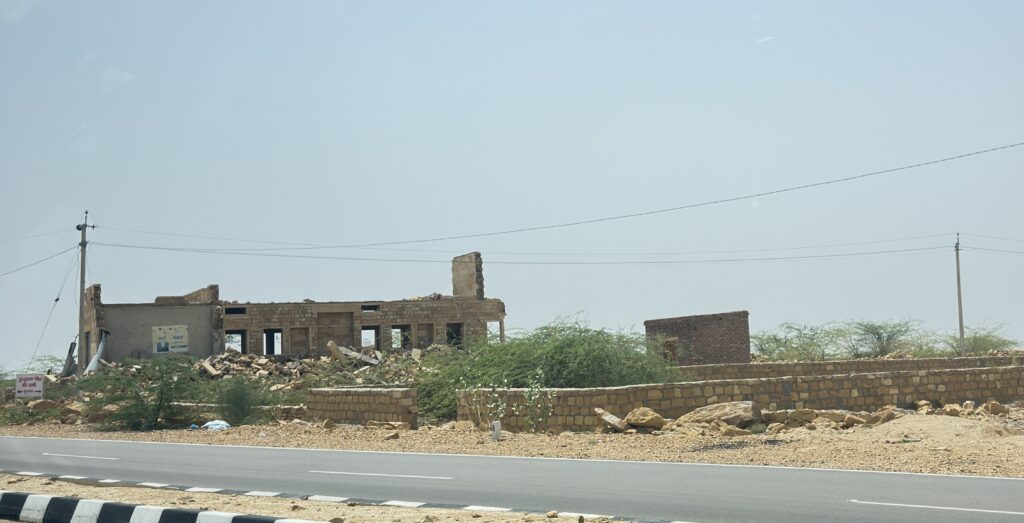
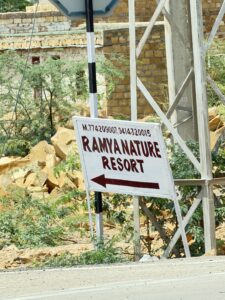
On the drive we passed a string of “nature resorts,” a name that, after some reflection, we’ve decided must refer to the fact that when nature calls out here, you are indeed left to resort to basics.
By this point, the heat had stopped being scenery and become an opponent, so we retreated to our blessedly cool suite for a break, TVs and lukewarm bathrooms notwithstanding.
At 7 p.m. we ventured back out — five whole minutes this time — to catch the sunset at 7:30. It did not disappoint. A properly spectacular desert sunset, the kind that makes you forgive the heat for everything, and the perfect note to call it a day on.
The Rest of the Roll