China just dropped a 2.8-trillion-parameter open-source model. Silicon Valley is stress-eating. I am cautiously optimistic about what this means for my gate opener.
2.8 trillion!
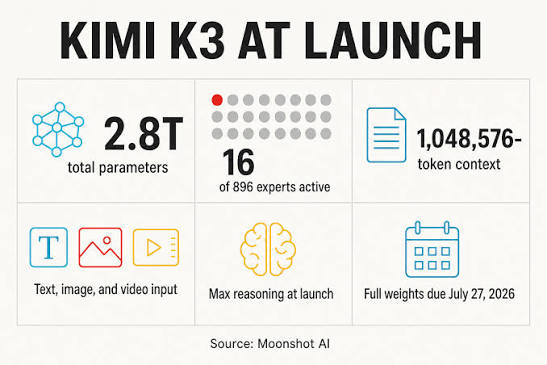
That is the number of parameters in Kimi K3, the new AI model from China’s Moonshot AI, which arrived over the weekend like an uninvited guest at a party that Silicon Valley thought it was hosting. Kimi K3 took the top spot on a major coding leaderboard, setting off fresh debate about the US-China AI rivalry and prompting American labs and investors to publicly reassess how far ahead the closed frontier really is.
To put 2.8 trillion in perspective: the human brain has roughly 100 billion neurons. Kimi K3 has about twenty-eight times as many parameters. Whether this means AI is smarter than humans is a question philosophers will enjoy arguing about for decades. What it clearly means is that someone in Beijing has been extremely busy and apparently doesn’t take weekends off.
Enterprises evaluating frontier models this quarter have been choosing among GPT-5.6, Claude, Grok 4.5, and now Kimi K3. The AI leaderboard, once a reliably American institution, now looks considerably more international. This is not unlike discovering that the restaurant you assumed was the best in town has been quietly outscored on every review platform by somewhere you hadn’t tried yet. Except this restaurant can also write code, summarize your emails, and explain the geopolitical implications of semiconductor export controls while you finish your tea.
What makes Kimi K3 particularly unsettling for American labs is the open part. It’s not a closed proprietary system accessed through a subscription and a terms-of-service agreement longer than a Victorian novel. Anyone can use it, study it, build on it. The implications of that are still being worked out, but “disruptive” seems like an understatement on the level of calling the Pacific “fairly large.”
Meanwhile, the European Commission adopted binding requirements under the Digital Markets Act ordering Google to open Android to rival AI assistants and to share portions of its search data with competitors, including AI developers. So while China is releasing the most powerful open model in the world, Europe is dismantling Google’s moat from the other direction. It is, technologically speaking, not the week Google had penciled into its vision board. I imagine their Monday morning meeting was very quiet and very long.
What This Means For Me Personally
I want to be honest about my relationship with AI. I am not building frontier models. I am not training neural networks. I am not writing papers about emergent capabilities or attending conferences where people argue about artificial general intelligence.
What I am doing is asking AI to help me research mundane household issues like gate-openers. And Wi-Fi extenders. And why my oven door won’t stay shut. And what exactly a mesh network is, explained as if I am a reasonably intelligent person who has better things to think about than mesh networks.
This is my AI use case. It is not glamorous. It will not appear in a TED talk. But here is the thing — I am genuinely excited about where all of this is going. Because if today’s AI can already explain gate openers, troubleshoot stuck oven doors, and research Wi-Fi extenders, imagine what 2.8 trillion parameters might do.
Maybe it will finally solve the oven door. Maybe it will write a crossword clue so elegant that 1978’s setters weep with admiration. Maybe it will design a Wi-Fi extender so good that I never have to think about mesh networks again.
Or maybe — and I suspect this is closer to the truth — it will do all of the above and then some, while simultaneously rewriting the rules of science, medicine, and civilization, and I will mostly use it to double-check whether I need to soak chickpeas overnight.
Either way, I am here for it. Fully, enthusiastically, unreservedly here for it. 2.8 trillion parameters. I just hope some of them are allocated to appliance troubleshooting.
Back to the Bigger Picture
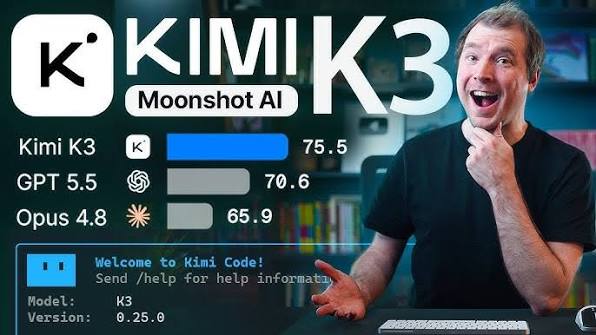
The gap between “frontier” and “everyone else” turns out to be narrower, and more contested, than the frontier labs would prefer. That is not a bad thing. Competition, historically, tends to produce better products faster. Whether those products are safe, wise, or being used well — those are separate conversations, and important ones.
But as a pure spectacle — as a demonstration of what happens when multiple well-resourced, highly motivated teams compete seriously on the same problem — it is genuinely extraordinary to watch.
Progress is wild.
Sources: