On India’s living heritage and the civilization that never stopped breathing
I’ve been thinking about the word old.
We use it for a 1970s Fiat, a loaf of bread gone green at the back of the fridge, a relative who still uses a chequebook. But when applied to India, old stops making sense as a word. India isn’t old the way ruins are old — silent, closed, finished. It’s old the way a river is old: still moving, still loud, still entirely capable of flooding your kitchen.
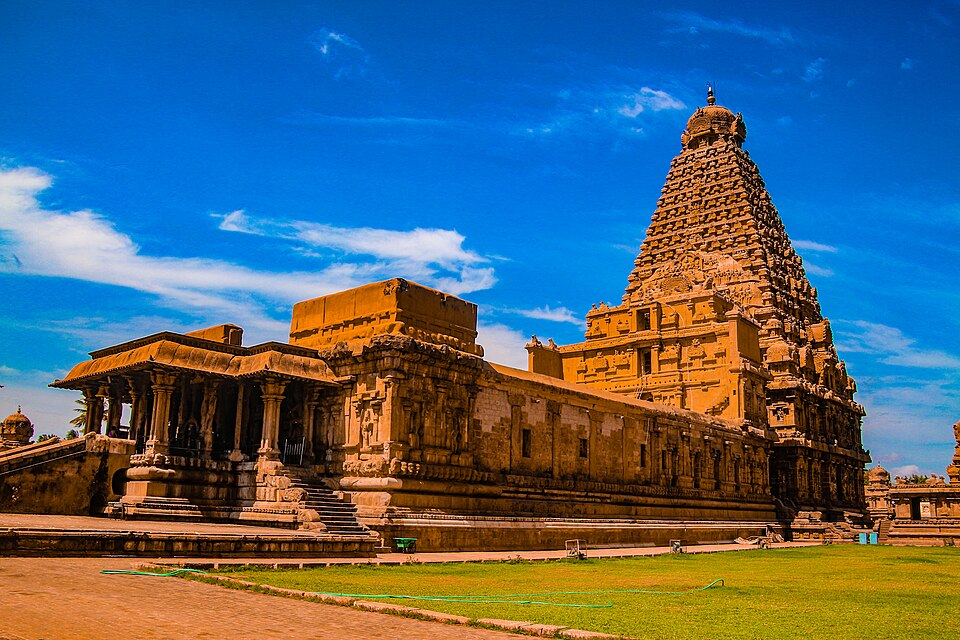
Standing in front of the Brihadeeswarar temple in Thanjavur, built in 1010 CE, I kept thinking: the Normans had just conquered England. The Aztec Empire didn’t exist yet. And here were artisans in Tamil Nadu hoisting an 80-tonne granite capstone to the top of a tower — without cranes, without computers, apparently without the existential anxiety the rest of us would have brought to the project. The tower is still standing. It is not in a museum. People worship there every morning. That’s the thing about India’s heritage that takes a while to register: it didn’t stop.
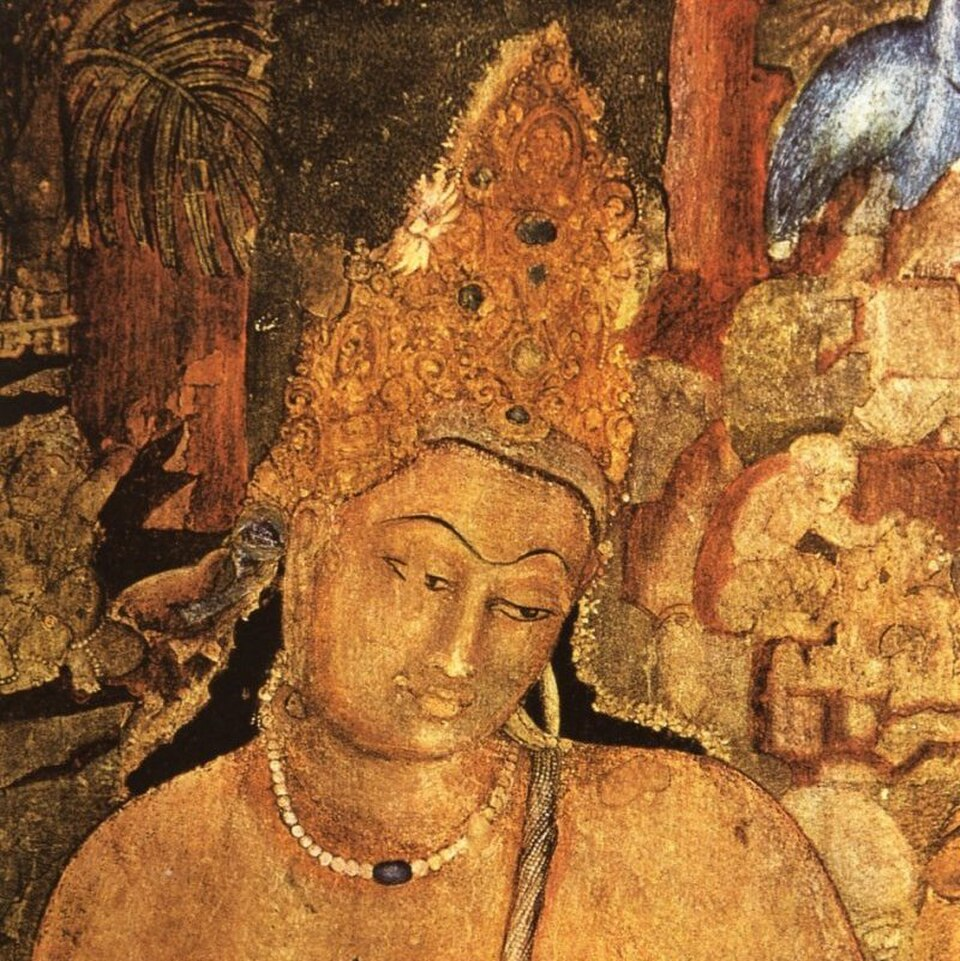
The caves at Ajanta were painted by artists working by the light of oil lamps and polished metal reflectors, sometime around the 2nd century BCE. The murals — bodhisattvas in jewels, elephants mid-dance, whole cities in miniature — were lost to the jungle for over a thousand years, rediscovered by a British hunting party in 1819, and are now considered among the finest paintings in the world. Ajanta is also frequently visited by school groups of ten-year-olds who treat it with the reverence children typically reserve for a moderately interesting Tuesday.
This is not a criticism. This is exactly right. In India, the extraordinary is simply where you live.
Take the Taj Mahal. Twenty thousand workers. Twenty-two years. A Mughal emperor in grief who wanted to build something that would make the universe briefly feel the absence of his wife. The marble changes colour: pink at dawn, white at noon, gold at dusk, silver by moonlight. There are people who have seen it a hundred times and still pull out their phone the moment the light shifts. And there are locals nearby who are mostly annoyed by the traffic.
Both responses are correct.
Languages in India are their own kind of monument — except they walk around and argue.
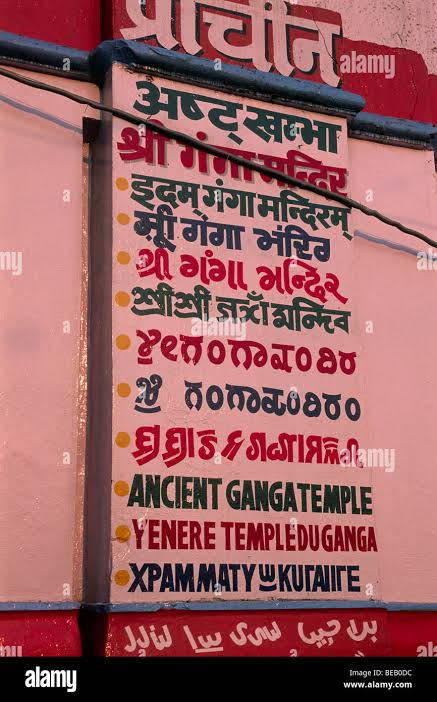
Tamil has a classical literature that predates the Common Era. Pāṇini wrote a grammar of Sanskrit in the 4th century BCE so complete and structurally rigorous that modern linguists still cite it. The Kathak dancer performing in Delhi tonight is executing a vocabulary of movement that was codified in texts older than the printing press.
This is the detail that floors me whenever I sit with it: the thread did not break. Not through invasions, not through colonialism, not through Partition. A scholar today can read 2,000-year-old Sangam Tamil poetry in the original. A grandmother in Varanasi hums a thumri that her grandmother taught her, who learned it from hers. The transmission happened, quietly, in kitchens and classrooms and music rooms, while empires rose and fell overhead.
I live with a small example of this multilingual inheritance. My husband speaks four languages — three more than me, a gap neither of us discusses but which I notice constantly. What he does with them is less code-switching and more free jazz: yesterday he asked “Service kammi hai?” — service English, kammi Tamil for lacking, hai Hindi for is. Three languages, one sentence, one verdict on the restaurant. When we travel abroad, his strategy simplifies but doesn’t entirely improve: in any non-English-speaking country he defaults to Spanish for courtesy, regardless of geography. He said gracias to our Egyptian tour guide. He said gracias to a Japanese ticket vendor. Both smiled the patient smile of people who have seen worse. He is, in his own small way, a continuation of the same impulse — languages as living things, borrowed and blended and carried forward, never quite staying where you put them.
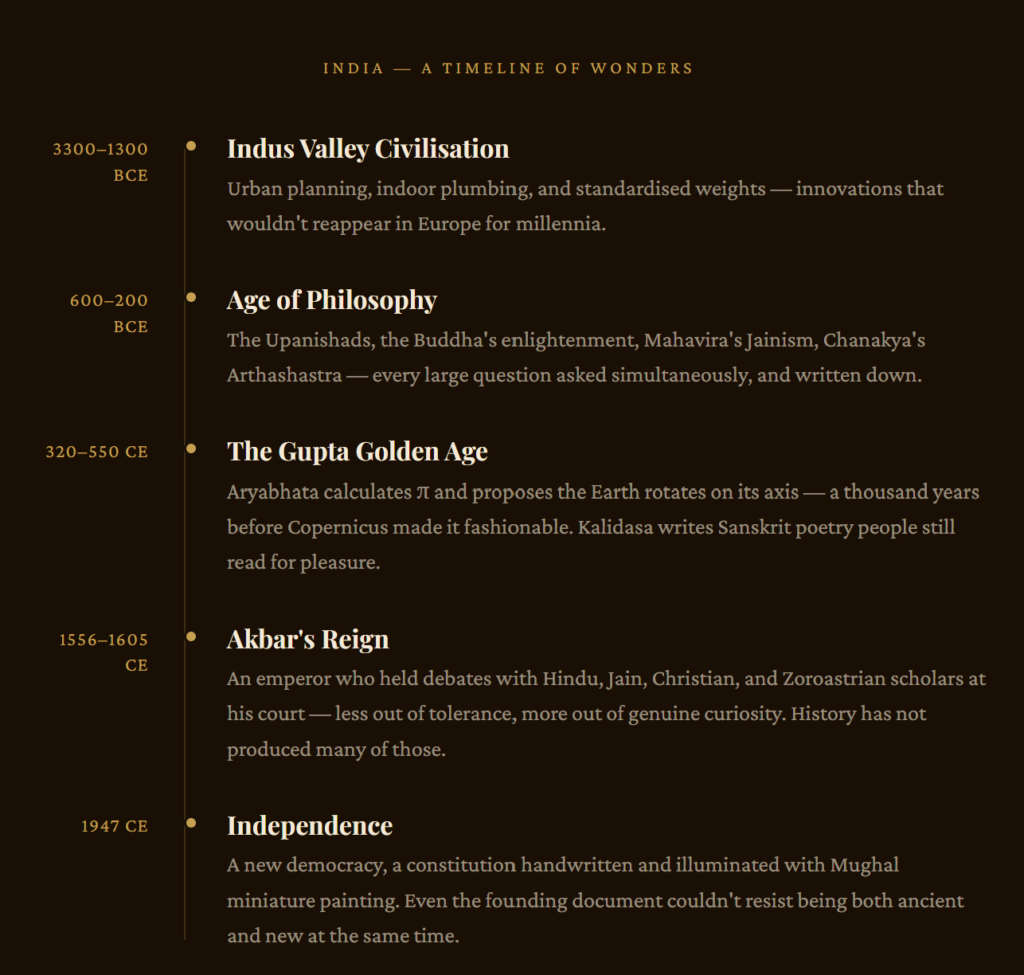
And then there’s the small matter of India having invented the number zero.
Also the decimal system. Also the calculation of π. Also heliocentric theory — Aryabhata proposed in 499 CE that the Earth rotates on its axis, over a thousand years before Copernicus made it fashionable in Europe. The Gupta period, roughly 320 to 550 CE, produced mathematics, astronomy, literature, and philosophy at a rate that suggests either extraordinary civilisational luck or a lot of very disciplined people who didn’t sleep enough.
Meanwhile, Kalidasa was writing Sanskrit poetry that people still read for pleasure. Not for exams. For pleasure.
“India is not a country. It is a conversation — one that has been going on for five thousand years and shows no sign of concluding.”— the Ganges Ghats

Before globalisation, there were spice routes. And at the centre of every spice route was India.
Pepper, cotton, cardamom, silk, indigo — these are the reasons Vasco da Gama sailed, the reasons Columbus went the wrong way and found a continent he hadn’t planned on, the reasons a trading company founded in London eventually ended up ruling a subcontinent. Much of modern history is, if you squint, an extended argument about who gets to control what India produces.
Even now: step into a kitchen anywhere on earth. Turmeric in a Thai curry. Cardamom in a Scandinavian pastry. Chilli — which arrived in India via Portuguese trade in the 1500s and was adopted so enthusiastically it now feels like it’s always been there — in a Mexican mole, a Korean kimchi, a Ghanaian stew. India didn’t just trade spices. It rewired the world’s palate.
What I keep noticing is something more structural: India is a civilisation that has always found ways to hold contradictions without resolving them. Ancient and modern. Sacred and chaotic. Mathematically precise and philosophically unbounded. The Upanishads spent centuries asking what is real? While also, presumably, dealing with monsoons and difficult neighbours.
I’ve read plenty of writing about India that reaches, at some point, for the word spiritual. It’s not wrong. But it’s also not quite enough.
Maybe that’s the heritage worth paying attention to. Not just the temples — gorgeous as they are. Not just the mathematics or the music or the manuscripts. But the underlying habit of mind: that the world is vast and strange, that certainty is a small room, and that a good question is worth more than a tidy answer.
India has been asking good questions for five thousand years. It doesn’t seem to be stopping anytime soon.
If you’ve been to India, you know there’s something I haven’t mentioned. There always is. That’s rather the point.