How a guitar-playing IIT friend made me realize that Dwight Eisenhower and my spreadsheet have been quietly collaborating for years.
A while ago, I wrote a blog called “Confessions of a To-Do List Addict: How I Outsourced My Brain“ — a chronicle of my long journey through notebooks, planners, sticky
notes, Evernote, OneNote, and every other organizational system known to humanity before finally arriving at what I considered the pinnacle of productivity:
Excel.
Not a simple spreadsheet. A living, breathing ecosystem. A digital extension of my frontal lobe. A place where every appointment, idea, errand, project, reminder, recipe, article, travel dream, crossword clue, and random thought could live safely outside my head.
The beauty of the system was simple: I no longer had to remember things. Excel remembered them for me. I was perfectly happy with this arrangement until our friend Sam Kanti got me thinking.
Sam is my husband’s colleague from IIT Madras. I first met him years ago at an IIT reunion, and many of our friends know him from our Spring Parties, where he arrives with a guitar and somehow gets an entire room singing along to 80s rock-and-roll classics.
Recently, Sam mentioned the Eisenhower Matrix. And suddenly I found myself comparing a presidential productivity framework with my beloved spreadsheet.
Excel: The Great Collector
My spreadsheet has one guiding principle: no thought left behind.
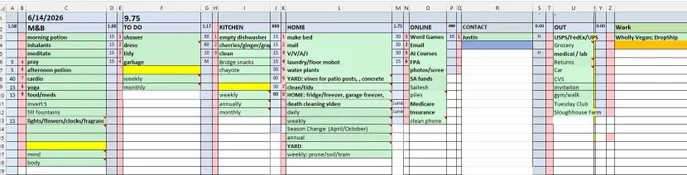
Need to renew a passport? Into Excel. Need to schedule a dental appointment? Into Excel. Need to buy cumin seeds? Into Excel. Need to investigate whether a cryptic crossword setter in 1978 was being unfair? Definitely into Excel.
My spreadsheet never asks whether a task is important. It never asks whether it’s urgent. It never asks whether I really need to spend an hour researching something that started as a five-minute curiosity.
Excel simply opens its arms and says, “Come in. There’s always room for one more row.”
Eisenhower: The Ruthless Editor
The foundational principle of the matrix comes from a speech Eisenhower gave in 1954, where he quoted an unidentified university president:
“I have two kinds of problems: the urgent and the important. The urgent are not important, and the important are never urgent.”
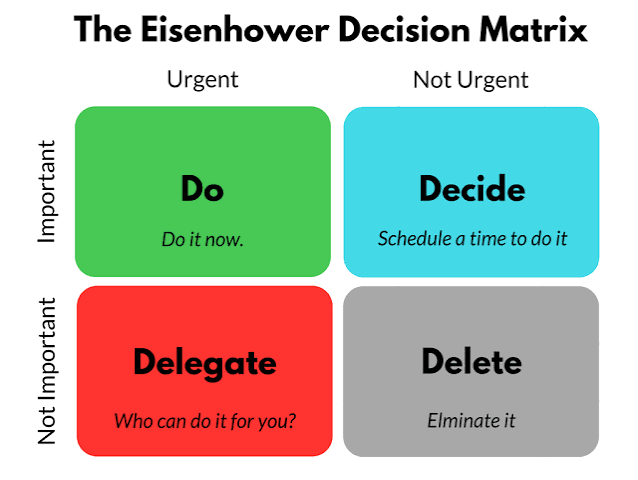
The Eisenhower Matrix is much less sentimental. Every task must fit into one of four boxes: important and urgent — do it. Important but not urgent — schedule it. Urgent but not important — delegate it. Not urgent and not important — eliminate it.
Elegant. Simple. Efficient. And slightly terrifying.
Because, unlike Excel, Eisenhower immediately starts asking difficult questions. “Is this actually important? Does this really need your attention? Why exactly are you comparing twelve different Wi-Fi extenders?”
It felt less like a productivity tool and more like a stern school principal.
Then I Had a Realization
As I started comparing the Matrix to my spreadsheet, I discovered something that gave me a renewed appreciation for my system.
My spreadsheet wasn’t merely collecting tasks. It was prioritizing them all along.
Every category in my spreadsheet has a second column devoted entirely to priority. That’s the secret sauce. When I want to decide what to tackle next, I don’t stare helplessly at hundreds of tasks — I simply sort by the priority column within that category. The most important items rise to the top. The less important ones quietly drift downward.
The system is beautifully simple. And remarkably effective.
The Eisenhower Matrix gets all the books, TED talks, and management seminars. My humble spreadsheet gets none of the glory. Yet every time I sort by that priority column, I’m effectively answering the same question Eisenhower was trying to solve: what should I focus on next?
So while Eisenhower asks “Is this important and urgent?” my spreadsheet asks “Compared to everything else in this category, where does this belong?” That’s a subtle but powerful distinction. Life rarely presents us with only four neat boxes. More often, it presents us with twenty-seven things that are all somewhat important. The priority column sorts out those nuances.
The Missing Fifth Quadrant
The longer I thought about Eisenhower, the more convinced I became that his famous Matrix is missing something.
There should be a fifth box: Fascinating but Entirely Unnecessary.
This is where curiosity lives. This is where one crossword clue leads to a dictionary, which leads to an article, which leads to another article, and suddenly you’re learning about ancient trade routes or Viking ship construction. This is where gate intercoms become a hobby, and Wi-Fi extenders become a research project. This is where many of life’s most enjoyable rabbit holes reside.
And I refuse to eliminate them. After all, if curiosity had to pass an Eisenhower test every time, half the fun of life would disappear.
Giving Credit Where Credit Is Due
What Sam really helped me see wasn’t that I needed to abandon my spreadsheet. Far from it. He helped me recognize why it has worked so well all these years.
The spreadsheet and the Eisenhower Matrix solve related but different problems. Eisenhower answers: What deserves attention? My spreadsheet answers: how do I keep track of everything and then decide what deserves attention first?
The unsung hero is that priority column. It’s not flashy. It’s not part of a bestselling management book. It doesn’t have a fancy name. But by assigning priorities and sorting on them, I’ve been creating my own practical version of task triage for years.
Not bad for a humble Excel sheet.
Final Thoughts
So thank you, Sam Kantimathi. A casual conversation from a fellow IIT veteran, occasional Spring Party guitarist, and champion of 80s rock-and-roll led me to an unexpected conclusion:
Dwight Eisenhower and my Excel spreadsheet are not rivals. They’re cousins. One gives us a framework. The other gives us a place to put everything. And somewhere between Eisenhower’s four boxes and my endlessly sortable rows lies the system that has kept me reasonably organized for years.
Naturally, after all this reflection, I created a new task in Excel: Review the Eisenhower Matrix. Priority: 1.
Because if there’s one thing a lifelong spreadsheet enthusiast knows how to do, it’s respond to a new productivity idea by adding another row.
For further reading on the subject of Time Management:
https://en.wikipedia.org/wiki/Time_management#Eisenhower_method